· Hernán Pérez Rodal · Engineering · 3 min read
RAG over 10+ databases: what production taught us
Why vector-only RAG doesn't scale in compliance, how we designed hybrid retrieval across multiple stores, and the architectural decisions that worked in production.
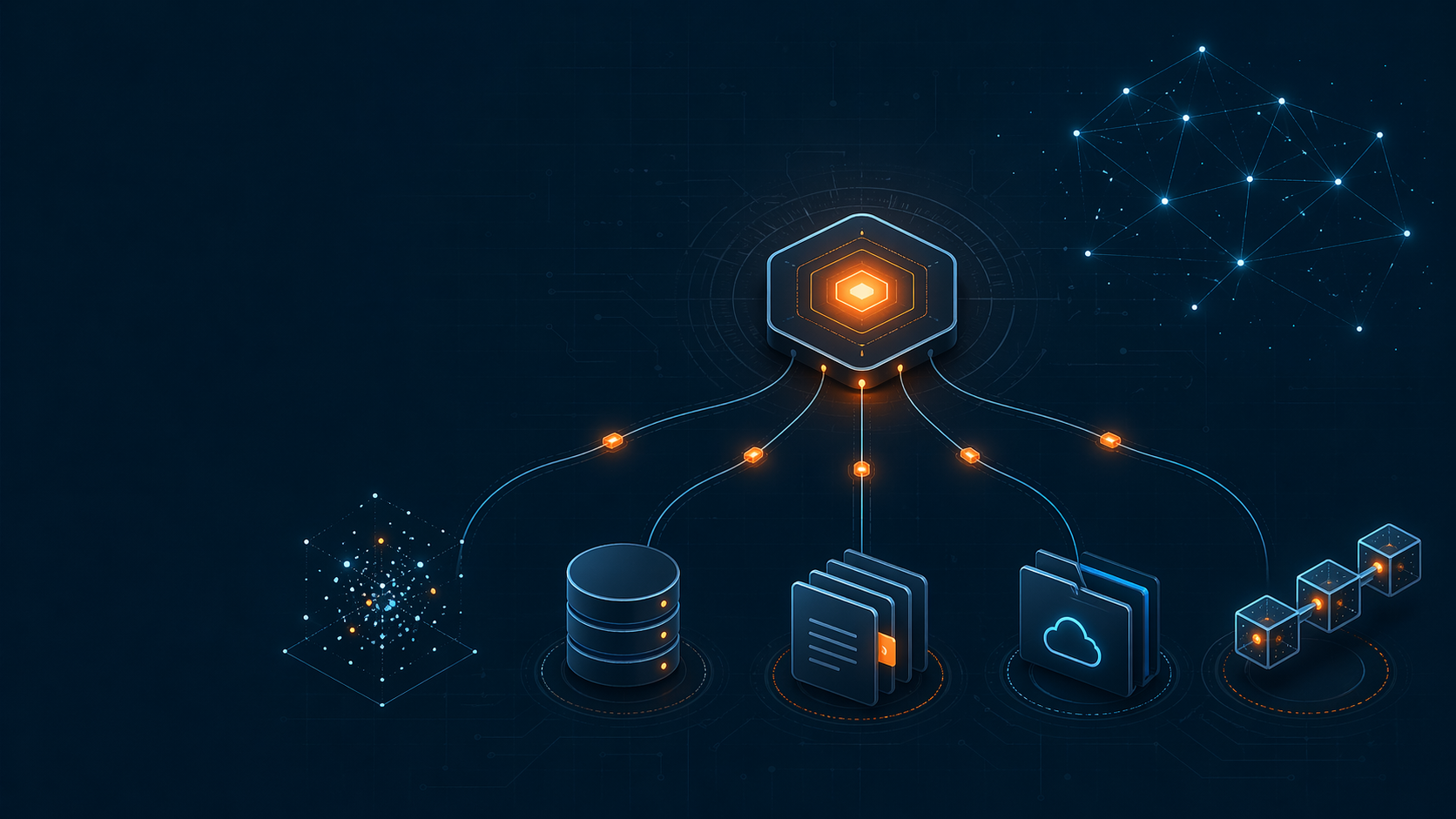
TL;DR: In 2026 the consensus is clear: vector-only RAG doesn’t scale in production. At Darwin we built an agentic compliance system with hybrid retrieval across 10+ databases. The best decisions we made had nothing to do with the model, they were about the data layer.
The problem
Our agentic compliance system has to answer questions like:
“Which mango lots from producer X, processed between May and July, met the CTEs required by FSMA 204, and which ones have evidence gaps?”
A single question that combines:
- Regulatory knowledge (FSMA 204 CTE/KDE definitions, structured text)
- Traceability events (CTEs recorded with timestamp, geolocation, supplier, lot)
- Internal business rules (gap analysis, risk scoring, dynamic logic)
- Relationships between entities (producer → plant → shipment → retailer)
A single vector store with embeddings of everything mixed together can’t answer that well. The right answer requires joining structured data + semantic retrieval + aggregate computation.
The architecture
Our retrieval stack:
| Source | Type | Usage |
|---|---|---|
| Qdrant | Vector store | Regulations, doctrine, historical cases (unstructured data) |
| PostgreSQL | Relational | Traceability events (CTE/KDE with timestamps, IDs, geo) |
| Firebase/Firestore | Document | Per-customer config, UI state |
| Cloud Storage | Blob | Original PDFs, audit trails, digital evidence |
| On-chain (Polygon) | Immutable | Critical attestations, digital signatures |
The agent doesn’t know where each thing lives, the orchestrator resolves it.
LangGraph as orchestrator
We use LangGraph to route queries in multiple steps:
- Classify: what kind of question is it (regulatory / operational / mixed)
- Plan: which retrievals are needed (vector + SQL + graph traversal)
- Fan-out: execute retrievals in parallel
- Synthesize: pass results to the LLM with structured context
- Validate: guardrails to prevent hallucinations on numeric data
The key step was #2: giving the LLM a query planner that decides the retrieval strategy before going to fetch. Without that, the model hallucinates data or pulls in irrelevant context.
What didn’t work
Vector-only with aggressive chunking: our first attempt. It failed on two fronts:
- Counting / aggregation queries (how many lots? weekly average?), the LLM made up numbers when they weren’t explicitly in context
- Relational joins (producer X + time window Y + certification Z), impossible without a structured query
The fix wasn’t “better chunking”, it was separating semantic retrieval from structured queries.
What did work
Explicit query routing → the planner decides whether a question requires vector search, SQL, graph traversal, or a mix.
Numeric guardrails → if the LLM’s answer contains numbers, we verify they match what the structured query returned. If not, fail fast instead of returning wrong data.
Semantic caching at the similar-questions level → cuts LLM costs by ~40% without impact on quality.
Full-trace observability with OpenTelemetry → every query is tracked end-to-end (planner → retrieval → LLM → guardrails). Critical for debugging.
Lessons learned
- The bottleneck of RAG in production isn’t retrieval, it’s deciding which retrieval to use
- Numeric guardrails save lives when the correctness of an answer drives regulatory decisions
- LangGraph beats linear chains for orchestrating conditional retrievals
- Multi-store + planner > single vector store with better chunking
- LLMs will hallucinate on structured aggregations: no matter how good the model is
What’s next?
The next iteration is to replace some planner rules with router fine-tuning using real production examples. The planner as an LLM is flexible but expensive, caching its decisions into a smaller model is a logical step.
If you’re building RAG for regulated domains, my advice is: start with the query planner, not the vector store.
Are you building something similar? Let’s talk, we’re open to sharing architecture and learning from other cases.